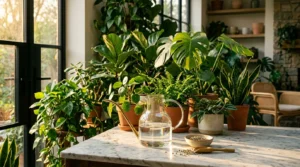

Feeding Your Green Friends: The Beginner’s Guide to Houseplant Fertilizing

Why Do Our Houseplants Need “Food,” Anyway?
You’ve got the watering down, your plants are enjoying their bright spot by the window, and they seem generally happy. But what if I told you there’s another secret ingredient to truly thriving, lush houseplants? It’s not magic, it’s fertilizer! Think of it like a vitamin boost for your green companions. While sunlight and water are absolutely essential, they don’t provide all the building blocks your plants need to grow big, strong, and beautiful.
Table Of Content
- Why Do Our Houseplants Need “Food,” Anyway?
- When to Fertilize: Listening to Your Plant’s Stomach
- The Growing Season is Key
- Signs Your Plant Might Be Hungry
- Choosing the Right Meal: Types of Houseplant Fertilizers
- Understanding N-P-K Ratios
- Liquid vs. Slow-Release vs. Organic Options
- The Golden Rule of Fertilizing: How to Feed Without Overfeeding
- Dilution is Your Best Friend
- How to Apply
- Common Mistakes to Avoid
- Fertilizing Specific Plants & Quick Tips
- What to Do This Week
- Frequently Asked Questions
- Why do houseplants need fertilizer?
- When is the best time to fertilize houseplants?
- What are the signs that a houseplant needs fertilizer?
- What do the N-P-K numbers on fertilizer labels mean?
- Can I fertilize a stressed or sick houseplant?
Just like we need a balanced diet, plants need specific nutrients to perform their best. In nature, plants get these from the soil, which is constantly replenished by decomposing organic matter. But in a pot, your houseplant is stuck with a finite amount of soil, and over time, it simply runs out of vital nutrients. That’s where fertilizing comes in – it’s how we replenish those essential elements so your plants can continue to flourish.
These essential nutrients are broadly categorized into macronutrients (needed in larger amounts) and micronutrients (needed in smaller amounts). The big three macronutrients you’ll hear about most are Nitrogen (N), Phosphorus (P), and Potassium (K), often represented as an N-P-K ratio on fertilizer labels. We’ll dive deeper into what those mean in a bit, but for now, just know they’re the main players in your plant’s nutritional symphony!
When to Fertilize: Listening to Your Plant’s Stomach
This is arguably the most crucial part of fertilizing: timing. Giving your plant food at the wrong time can be worse than not feeding it at all! The general rule of thumb is to fertilize only when your plant is actively growing. So, how do you know when that is?
The Growing Season is Key
For most houseplants, the active growing season is during the warmer, brighter months of spring and summer. This is when they put out new leaves, stems, and sometimes even flowers. As the days shorten and temperatures drop in fall and winter, most plants enter a period of dormancy, slowing down their growth significantly. Fertilizing a dormant plant is like force-feeding someone who’s asleep – it won’t do any good and can actually cause harm by leading to a buildup of salts in the soil, which can burn delicate roots.
So, mark your calendar: generally, start fertilizing in early spring (think March or April) and continue through late summer (August or September). Some fast-growing plants might appreciate a light feed into early fall, but always err on the side of caution. If you’re unsure, it’s always better to skip a feeding than to over-fertilize.
Signs Your Plant Might Be Hungry
Your plants can tell you when they’re running low on nutrients. Look for signs like overall slow or stunted growth, smaller-than-usual new leaves, or a general paleness or yellowing of older leaves, especially if you’re already providing adequate light and water. If your plant hasn’t been repotted in a year or two, its soil has likely been depleted. A happy, well-fed plant will typically show vigorous growth and vibrant foliage during its active season.
However, let me add something here: don’t fertilize a plant that’s already stressed! If your plant is struggling with pests, root rot, or recovering from a move, give it time to recuperate before adding fertilizer to the mix. Think of it this way: you wouldn’t give a sick person a huge meal, right? Let them get better first.
Choosing the Right Meal: Types of Houseplant Fertilizers
Walking down the fertilizer aisle can feel overwhelming with all the numbers and types. But don’t worry, it’s simpler than it looks once you understand a few key things.
Understanding N-P-K Ratios
Remember those N-P-K numbers? They represent the percentage by weight of Nitrogen (N), Phosphorus (P), and Potassium (K) in the fertilizer. Here’s a quick rundown of what each does:
- Nitrogen (N): Promotes lush, green, leafy growth. Great for foliage plants like Pothos, Monstera, and Philodendron.
- Phosphorus (P): Supports strong root development, flowering, and fruiting. Important for plants that bloom, like African Violets.
- Potassium (K): Contributes to overall plant health, disease resistance, and water regulation. Essential for all plants.
For most houseplants, especially if you’re just starting, a balanced fertilizer like a 10-10-10 or 20-20-20 (meaning equal parts N, P, and K) is an excellent choice. This provides a good all-around nutrient boost. You might opt for a higher-nitrogen fertilizer (e.g., 20-10-10) if you want to encourage more leafy growth, or a “bloom booster” (e.g., 10-20-10) for flowering plants.
Liquid vs. Slow-Release vs. Organic Options
There are a few popular forms of fertilizer, each with its pros and cons:
- Liquid Fertilizers: These are concentrated liquids that you dilute with water. They offer excellent control over the amount you’re feeding and are immediately available to the plant. This is my personal preference for most houseplants because you can easily adjust the strength. Brands like Miracle-Gro Indoor Plant Food or Espoma Organic Indoor Plant Food are popular choices.
- Slow-Release Granules or Spikes: These are mixed into the soil or pushed into the soil around the plant. They release nutrients slowly over several months, meaning less frequent application. While convenient, you have less control, and it’s harder to stop the release if you notice signs of over-fertilization. Osmocote is a well-known brand for granules.
- Organic Options: Things like worm castings (which you can top-dress the soil with), fish emulsion, or compost tea offer nutrients from natural sources. They tend to improve soil health over time and are generally gentler. They might have a slight odor, though!
For beginners, I usually recommend a balanced liquid fertilizer. It allows you to learn about your plant’s needs and adjust more easily than a slow-release product.
The Golden Rule of Fertilizing: How to Feed Without Overfeeding
This is where most beginners (and even some seasoned plant parents!) make mistakes. It’s tempting to think “more is better,” but with fertilizer, that’s definitely not the case. Over-fertilizing is a much more common and damaging problem than under-fertilizing.
Dilution is Your Best Friend
The most important piece of advice I can give you is this: always dilute your liquid fertilizer to half or even quarter strength of what the manufacturer recommends. Seriously. Most fertilizer instructions are designed for outdoor garden plants that are in much larger volumes of soil and exposed to more frequent watering, which flushes nutrients away. Indoor plants in pots are much more sensitive.
My go-to method is “weakly, weekly” during the peak growing season. This means using a very diluted solution (e.g., 1/4 or 1/2 strength) every time I water, or every other watering, rather than full strength once a month. This provides a consistent, gentle supply of nutrients without overwhelming the plant. For a typical balanced 10-10-10 liquid fertilizer, I might use 1/4 teaspoon per gallon of water every 2-4 weeks during the growing season, instead of the 1 teaspoon per gallon recommended for monthly feeding.
How to Apply
Before you fertilize, always make sure the soil is already slightly moist. Never apply fertilizer to dry soil, as this can shock the roots and cause serious burn. Water your plant thoroughly first, wait about 15-30 minutes for the water to drain, and then apply your diluted fertilizer solution. Pour it evenly over the soil surface, just as you would plain water.
For example, imagine this situation: you’ve got a beautiful Monstera deliciosa that’s looking a bit pale. It’s spring, and you’ve decided to give it some food. First, you water it thoroughly with plain water. Then, once the excess water has drained, you apply your half-strength diluted fertilizer solution. This simple step protects the roots from potential burn.
Common Mistakes to Avoid
- Over-fertilizing: This is the big one. Signs include crispy leaf edges, yellowing leaves, slowed growth, or a white crust forming on the soil surface (salt buildup). If you suspect over-fertilization, flush the soil thoroughly with plain water several times to rinse out excess salts.
- Fertilizing dormant plants: As we discussed, avoid feeding in fall and winter.
- Fertilizing dry plants: Always water first!
- Not diluting: Follow the “weakly, weekly” principle.
Fertilizing Specific Plants & Quick Tips
While the general rules apply to most plants, some have specific needs:
- Pothos, Philodendron, Monstera: These fast-growing leafy plants appreciate a balanced liquid fertilizer at half strength every 2-4 weeks during the growing season.
- Snake Plant (Sansevieria), ZZ Plant: These are very low-feeders. They might only need a quarter-strength balanced fertilizer once or twice during their entire growing season, or even just once a year. Less is definitely more for these tough guys.
- Calathea, Prayer Plant: These sensitive beauties prefer consistent, very dilute feeding. I’d suggest a quarter-strength balanced liquid fertilizer every 3-4 weeks in spring and summer, being careful not to overdo it.
A good moisture meter can also help you gauge when to water your plants, ensuring the soil is moist before you fertilize. It’s all about creating an optimal environment for them to thrive, isn’t it?
Honestly, fertilizing is less about exact measurements and more about observation and consistency. Start small, watch your plant’s reaction, and adjust. You’ll develop a feel for it over time. After all, you’re the best judge of your plant’s health, and you’ve “been there, done that” with dozens of plants in your own home, just like me!
What to Do This Week
This week, grab a balanced liquid houseplant fertilizer (like a 10-10-10 or 5-5-5). If your plants are actively growing and the soil is moist, try feeding them with a solution diluted to half or even quarter strength of the manufacturer’s recommendation. Observe their reaction over the next few weeks and notice the difference! Remember, you’re not just feeding your plants; you’re nurturing a relationship that brings so much joy and beauty into your home.
Frequently Asked Questions
Why do houseplants need fertilizer?
Houseplants need fertilizer because they require specific nutrients to grow big, strong, and beautiful. While sunlight and water are essential, they don't provide all the building blocks that plants need. Fertilizer replenishes the essential elements in the soil, allowing plants to continue to flourish. In nature, plants get these nutrients from the soil, which is constantly replenished by decomposing organic matter, but in a pot, the soil can become depleted over time.
When is the best time to fertilize houseplants?
The best time to fertilize houseplants is during the active growing season, which is typically during the warmer, brighter months of spring and summer. This is when plants put out new leaves, stems, and sometimes even flowers. Fertilizing during this time helps to promote healthy growth and development. It's generally recommended to start fertilizing in early spring and continue through late summer.
What are the signs that a houseplant needs fertilizer?
Signs that a houseplant needs fertilizer include overall slow or stunted growth, smaller-than-usual new leaves, or a general paleness or yellowing of older leaves. If a plant hasn't been repotted in a year or two, its soil has likely been depleted of nutrients. A happy, well-fed plant will typically show vigorous growth and vibrant foliage during its active season.
What do the N-P-K numbers on fertilizer labels mean?
The N-P-K numbers on fertilizer labels represent the percentage by weight of Nitrogen (N), Phosphorus (P), and Potassium (K) in the fertilizer. Nitrogen promotes lush, green, leafy growth, Phosphorus supports strong root development, and Potassium helps with overall plant health and resistance to disease. Understanding the N-P-K ratio can help you choose the right fertilizer for your specific plant's needs.
Can I fertilize a stressed or sick houseplant?
No, it's not recommended to fertilize a stressed or sick houseplant. If a plant is struggling with pests, root rot, or recovering from a move, it's best to give it time to recuperate before adding fertilizer to the mix. Fertilizing a stressed plant can cause more harm than good, so it's best to wait until the plant is healthy and thriving before fertilizing.