Snake Plant vs. ZZ Plant vs. Spider Plant: Your Ultimate Beginner Houseplant Battle

Choosing Your First Green Friend: The Ultimate Beginner Houseplant Battle
Ever feel a little overwhelmed staring at the rows of gorgeous plants at the nursery, wondering which one won’t immediately decide your home is its final resting place? You’re not alone! Picking a truly resilient, low-maintenance plant for your indoor space is key to building confidence and a thriving collection. Today, we’re putting three of the absolute titans of easy houseplant care head-to-head: the Snake Plant, the ZZ Plant, and the Spider Plant. These aren’t just pretty faces; they’re practically bulletproof, making them perfect for anyone from busy professionals to first-time plant parents.
Table Of Content
- Choosing Your First Green Friend: The Ultimate Beginner Houseplant Battle
- The Low-Maintenance Champions: Snake Plant & ZZ Plant
- Snake Plant (Sansevieria trifasciata): The Indestructible Icon
- ZZ Plant (Zamioculcas zamiifolia): The Drought Defender
- The Prolific Propagator: Spider Plant
- Spider Plant (Chlorophytum comosum): The Baby Maker
- Head-to-Head Comparison: Who Wins Your Space?
- Common Mistakes to Avoid with These Easy Plants
- Making Your Choice & Quick Takeaway
- What to do this week
- Frequently Asked Questions
- What are the benefits of having a Snake Plant in your home?
- How often should I water my ZZ Plant?
- What kind of soil is best for a Snake Plant?
- Can I grow a ZZ Plant in low-light conditions?
- Which plant is more forgiving for beginners, the Snake Plant or the ZZ Plant?
I remember my first foray into houseplants – a well-meaning but ill-fated fern that quickly shriveled despite my best efforts. It taught me a crucial lesson: start with plants that forgive a little neglect. That’s exactly what these three offer. We’ll dive into what makes each one special, their care requirements, and help you decide which one is the perfect match for your lifestyle and home. Let’s get started and find your new green companion!
The Low-Maintenance Champions: Snake Plant & ZZ Plant
When it comes to sheer resilience and an ability to thrive on neglect, the Snake Plant and ZZ Plant are in a league of their own. They’re like the superheroes of the plant world, able to withstand conditions that would send other plants wilting faster than you can say “photosynthesis.” If you’re someone who travels often, forgets to water, or simply wants a plant that demands very little, these two are your top contenders.
Snake Plant (Sansevieria trifasciata): The Indestructible Icon
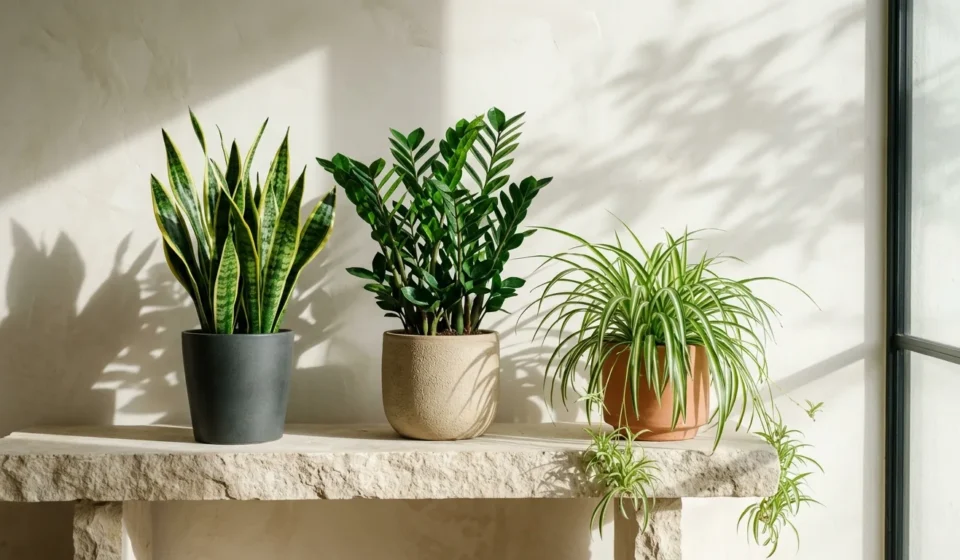
Often called “Mother-in-Law’s Tongue,” the Snake Plant is famous for its sword-like, architectural leaves and incredibly forgiving nature. They come in various cultivars, like the popular ‘Laurentii’ with its striking yellow edges, or the compact ‘Hahnii’ bird’s nest variety. These plants are true survivors, perfect for beginners.
- Light: Snake Plants are incredibly adaptable. They will tolerate everything from low light corners (though growth will be slow) to bright indirect light. Avoid direct, harsh afternoon sun, which can scorch their leaves.
- Water: This is where most plant parents go wrong with a Snake Plant – they overwater! They prefer to be on the drier side. Water thoroughly only when the soil is completely dry, typically every 2-4 weeks, or even longer in low light conditions. When in doubt, wait another week.
- Soil: A well-draining potting mix is crucial. I like to use a standard houseplant potting mix amended with about 30% perlite or pumice to ensure excellent drainage and prevent root rot.
- Benefits: Known for air-purifying qualities, removing toxins like formaldehyde and benzene. They’re also incredibly stylish and versatile for any decor.
For example, imagine this situation: you’ve planned a two-week vacation, and you completely forgot to water your plants before you left. When you return, your Snake Plant will likely be just fine, patiently waiting for a drink. It’s almost impossible to kill these with underwatering.
ZZ Plant (Zamioculcas zamiifolia): The Drought Defender
The ZZ Plant, with its thick, waxy, deep green leaves and upright growth, is another champion of neglect. Its rhizomatous roots store water, allowing it to go for extended periods without a drink. It’s sleek, modern, and practically indestructible.
- Light: Similar to the Snake Plant, the ZZ Plant can tolerate a wide range of light conditions, from low to bright indirect light. It will grow fastest and lushest in brighter conditions, but truly excels in low-light environments where many other plants would struggle.
- Water: This is the ZZ Plant’s superpower. It can go for weeks, sometimes even months, without water. Wait until the soil is completely dry to the touch, often every 3-6 weeks, before watering thoroughly. Overwatering is the quickest way to kill a ZZ Plant.
- Soil: Again, excellent drainage is paramount. A good quality potting mix with added perlite (around 30-40%) will ensure its water-storing rhizomes don’t sit in soggy conditions.
- Benefits: Extremely drought-tolerant, visually striking, and very pest-resistant. It’s also known to remove toxins from the air.
Honestly, if you’re looking for a plant you can truly forget about for a while, the ZZ Plant is your best bet. But what would you do in this situation if you notice its leaves starting to wrinkle slightly? That’s usually its subtle way of telling you it’s finally thirsty, a rare sign from such a stoic plant!
The Prolific Propagator: Spider Plant
While the Snake and ZZ Plants are masters of minimal fuss, the Spider Plant offers a different kind of joy: abundant, easy propagation. If you love sharing your plant babies with friends or expanding your collection for free, the Spider Plant is an absolute must-have. It’s also wonderfully forgiving in its own right.
Spider Plant (Chlorophytum comosum): The Baby Maker
The classic Spider Plant, with its arching green and white striped leaves, is instantly recognizable. What truly sets it apart are the “spiderettes” or plantlets it produces on long stems, making it look like a miniature green fireworks display. These plantlets are incredibly easy to propagate.
- Light: Spider Plants prefer bright, indirect light. They can tolerate medium light, but direct sun can scorch their leaves, and too little light will diminish their variegation and reduce the number of plantlets.
- Water: Unlike their desert-loving counterparts, Spider Plants prefer consistent moisture but not soggy soil. Water when the top inch or two of soil feels dry, usually every 7-10 days. They are sensitive to fluoride in tap water, which can cause brown tips, so consider using filtered or rainwater if you have this issue.
- Soil: A standard, good quality houseplant potting mix works well. They aren’t as particular about extreme drainage as Snake or ZZ Plants, but still appreciate a mix that doesn’t stay waterlogged.
- Propagation: This is where they shine! Simply snip off a spiderette (a baby plant with some roots already forming), and either place it in a glass of water until roots develop or pot it directly into moist soil. It’s incredibly satisfying, and based on my experience, almost foolproof.
- Benefits: Excellent air purifier, highly prolific, great for hanging baskets or shelves where their plantlets can dangle, and generally non-toxic to pets.
To be fair, while it’s still very low-maintenance, the Spider Plant does appreciate a little more attention than the “forget-me-not” Snake and ZZ Plants, particularly when it comes to consistent watering and brighter light. But its reward of endless baby plants is well worth it!
Head-to-Head Comparison: Who Wins Your Space?
Now that we’ve met our contenders, let’s put them side-by-side to help you make the best choice for your home and lifestyle. This isn’t about picking a “winner” overall, but finding the perfect fit for you.
| Feature | Snake Plant | ZZ Plant | Spider Plant |
|---|---|---|---|
| Light Tolerance | Very Low to Bright Indirect | Very Low to Bright Indirect | Medium to Bright Indirect |
| Watering Frequency | Every 2-4+ weeks (soil completely dry) | Every 3-6+ weeks (soil completely dry) | Every 7-10 days (top 1-2 inches dry) |
| Drought Tolerance | Excellent | Exceptional | Good |
| Growth Habit | Upright, architectural | Upright, bushy | Arching, trailing (with plantlets) |
| Pet Toxicity | Mildly toxic if ingested | Toxic if ingested | Non-toxic |
| Propagation Ease | Moderate (leaf cuttings) | Moderate (rhizome/stem cuttings) | Very Easy (plantlets) |
| Pest Resistance | Very High | Very High | High (can get spider mites occasionally) |
Common Mistakes to Avoid with These Easy Plants
- Overwatering: This is the number one killer for Snake and ZZ Plants. Remember, less is more! For Spider Plants, consistent moisture is good, but never let them sit in soggy soil. Consider using a moisture meter if you’re unsure.
- Ignoring light needs: While adaptable, putting a Spider Plant in a very dark corner or a Snake Plant in scorching direct sun will lead to problems. Try to match the plant to the light you have.
- Choosing the wrong pot: Ensure pots have drainage holes. Terracotta pots can be great for Snake and ZZ Plants as they help wick away excess moisture.
Making Your Choice & Quick Takeaway
So, which beginner houseplant is right for you? If you’re someone who often forgets to water, travels frequently, or wants a plant that thrives in genuinely low-light conditions, the Snake Plant or ZZ Plant will be your steadfast companions. They are the epitome of “set it and forget it.” If you love the idea of sharing plants, want something that adds a soft, trailing element to your decor, and are okay with slightly more frequent watering, the Spider Plant is an absolute delight.
Ultimately, you can’t go wrong with any of these three for starting your indoor plant journey. They are all fantastic entry points into the wonderful world of houseplants, offering beauty and resilience without demanding a complicated routine. My advice? If you have the space, get one of each! You’ll quickly see why they’re celebrated as the best starter plants around.
What to do this week:
Pick one of these fantastic starter plants! Head to your local nursery or garden center and choose a healthy-looking Snake Plant, ZZ Plant, or Spider Plant that calls to you. Bring it home, find a spot that matches its light needs, and resist the urge to water it immediately – especially for the Snake and ZZ. Let it settle in, and then follow the watering guidelines above. Happy planting!
Frequently Asked Questions
What are the benefits of having a Snake Plant in your home?
The Snake Plant is known for its air-purifying qualities, removing toxins like formaldehyde and benzene from the air. It's also incredibly stylish and versatile for any decor, making it a great addition to any home. Additionally, it's almost impossible to kill with underwatering, making it perfect for busy professionals or first-time plant parents. With its sword-like, architectural leaves, it's a great choice for those who want a low-maintenance yet stylish plant.
How often should I water my ZZ Plant?
The ZZ Plant can go for weeks, sometimes even months, without water. It's best to wait until the soil is completely dry to the touch before watering thoroughly. Overwatering is the quickest way to kill a ZZ Plant, so it's better to err on the side of caution and underwater slightly. Typically, you'll need to water your ZZ Plant every 3-6 weeks, depending on the light conditions and temperature of your home.
What kind of soil is best for a Snake Plant?
A well-draining potting mix is crucial for a Snake Plant. You can use a standard houseplant potting mix amended with about 30% perlite or pumice to ensure excellent drainage and prevent root rot. This will help your Snake Plant thrive and prevent waterlogged soil, which can be detrimental to its health. By using a well-draining potting mix, you'll be able to water your Snake Plant with confidence, knowing that the soil will dry out quickly and prevent root rot.
Can I grow a ZZ Plant in low-light conditions?
Yes, the ZZ Plant can tolerate a wide range of light conditions, from low to bright indirect light. It will grow fastest and lushest in brighter conditions, but it truly excels in low-light environments where many other plants would struggle. This makes it a great choice for rooms with limited natural light, such as basements or offices. With its thick, waxy, deep green leaves, the ZZ Plant can thrive in conditions that would be challenging for other plants.
Which plant is more forgiving for beginners, the Snake Plant or the ZZ Plant?
Both the Snake Plant and the ZZ Plant are incredibly forgiving and perfect for beginners. However, the Snake Plant is often considered more adaptable and easier to care for, as it can tolerate a wider range of light conditions and watering schedules. The ZZ Plant, on the other hand, is more sensitive to overwatering, so it requires a bit more caution when it comes to watering. Ultimately, both plants are great choices for beginners, but the Snake Plant might be a slightly more forgiving option.