
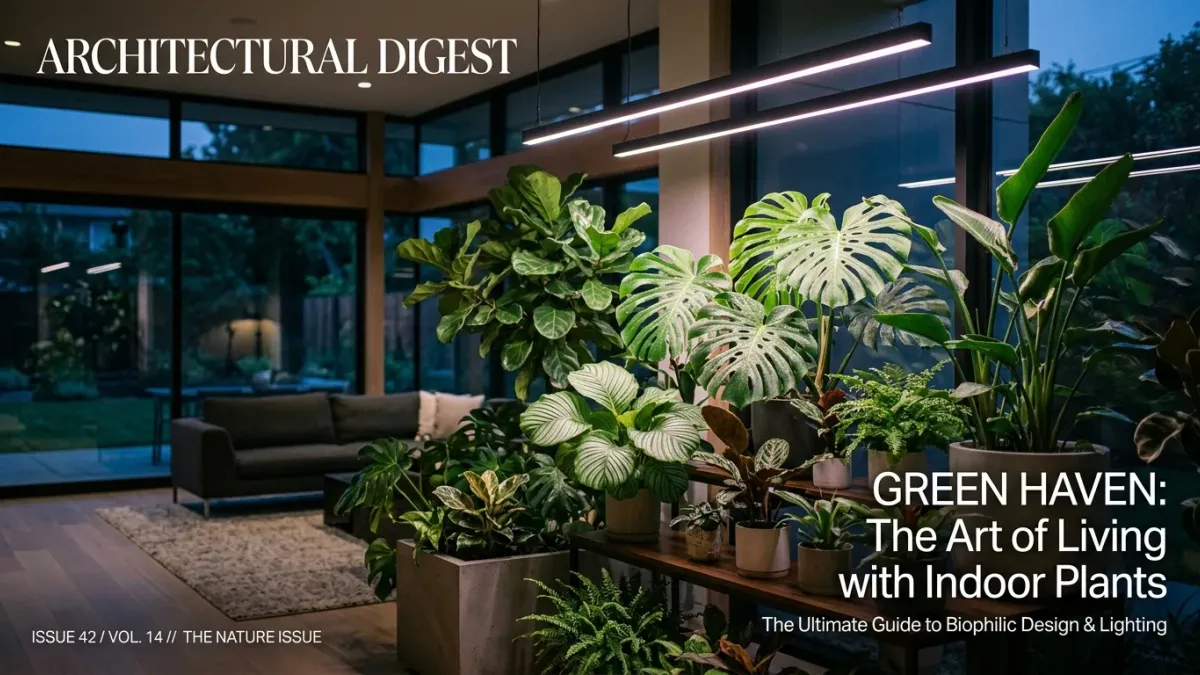
Quick answer: To keep houseplants thriving without sufficient sunlight, use full-spectrum LED grow lights delivering 200 to 500 foot-candles (2,150 to 5,380 lux) at leaf level. Position the fixture 6 to 18 inches above the top leaves and run it on an automatic timer for 12 to 16 hours daily to maintain steady, healthy growth.
Understanding Light: How Plants See Spectrum and Intensity
Human eyes and plant leaves process light through entirely different mechanisms. Our vision measures brightness using lumens, which heavily emphasizes green wavelengths that look brightest to us. Plants, however, rely on specific energy bands within the Photosynthetically Active Radiation (PAR) spectrum, spanning 400 to 700 nanometers (nm). To drive photosynthesis successfully indoors, your supplemental fixtures must provide these target wavelengths in adequate amounts to replace missing ambient sun.
Blue light (400–500 nm) stimulates strong foliage growth, thick stem development, and robust root systems. This spectrum is vital when rooting cuttings in water or keeping compact foliage plants from growing stretched and leggy. Red light (600–700 nm) fuels leaf expansion, overall biomass production, and eventual flowering. Modern full-spectrum LED lights combine these primary wavelengths into a clean, warm-white beam that looks visually appealing in your living room while supplying total photosynthetic energy.
Distance plays a crucial role in how much light actually reaches your foliage due to the inverse-square law. Doubling the distance between a fixture and a leaf cuts the light intensity down to one-quarter of its original power. For instance, a fixture emitting 600 foot-candles at 8 inches drops to a mere 150 foot-candles when moved back to 16 inches. Checking light levels using a dedicated meter or a calibrated smartphone app prevents hidden light starvation as well as leaf scorch.
Plant parent tip: When I first setup a high-output LED fixture over my display shelf, I scorched the thin, delicate leaves of my Calathea orbifolia within 48 hours because the bulb sat just 6 inches above the crown. Always acclimate sensitive plants by placing fixtures at least 18 to 24 inches away initially, then lower them gradually over two weeks while monitoring for pale, washed-out foliage or dry brown patches.
Choosing the Best Type of Grow Light
Selecting the right fixture depends on your space, budget, and aesthetic preferences. Modern indoor gardeners generally choose between three primary bulb technologies, though Light-Emitting Diodes (LEDs) have quickly established themselves as the industry gold standard for efficiency, longevity, and low operating temperatures.
LEDs draw minimal electricity while converting the majority of that energy directly into usable PAR, generating very little ambient heat. They come in versatile form factors, including standard E26 screw-in bulbs that fit your favorite accent lamps, sleek clip-on spotlights, and multi-tier hanging panels. Fluorescent T5 tubes remain an affordable option for wide seed-starting trays, but they emit more heat and experience significant spectrum decay after 12 to 18 months of continuous use. High-Intensity Discharge (HID) lights are generally impractical for home spaces due to extreme power draw and excessive heat production.
| Light Technology | Power Draw | Heat Output | Average Lifespan | Best Application |
|---|---|---|---|---|
| Full-Spectrum LED | 10–35 Watts | Very Low | 25,000–50,000 hours | All houseplants, multi-tier shelves, living rooms |
| Fluorescent (T5 / CFL) | 24–54 Watts | Moderate | 10,000–15,000 hours | Seedling trays, propagation racks, shallow shelves |
| High-Intensity Discharge (HID) | 250–1000 Watts | Very High | 5,000–10,000 hours | Enclosed greenhouses, fruiting trees, commercial grows |
Matching Houseplants to Light Levels and Requirements
Every plant species evolved under specific forest canopy conditions, meaning their daily energy requirements vary dramatically. Over-illuminating shade-loving plants bleaches their leaf pigments, while keeping light-hungry tropicals under weak bulbs results in tiny leaves, long internodes, and dropped lower foliage. To encourage lush growth, pair your species with the correct light intensity, measured in foot-candles or lux.
Low-Light Tolerant Species
Low-light resilient foliage like the snake plant (Sansevieria trifasciata 'Laurentii') and ZZ Plant (Zamioculcas zamiifolia) require only 50 to 150 foot-candles (500 to 1,600 lux) to maintain structural health. Placing these sturdy choices under a modest 10-watt full-spectrum bulb for 12 hours daily keeps them vibrant even in windowless hallways. Pair this lighting with a porous well-draining soil mix containing 30% perlite to protect roots from rotting under low metabolic activity.
Medium to Bright Indirect Light Species
Popular tropicals like Monstera deliciosa, Ficus elastica, and variegated Golden Pothos demand 300 to 800 foot-candles (3,200 to 8,600 lux) for robust growth and bold leaf fenestrations. Position a 24 to 36-watt LED panel roughly 12 to 18 inches above the leaf canopy. Under artificial light, these species metabolize water faster, so check soil moisture frequently and water thoroughly when the top 2 inches dry out. Maintain ambient indoor temperatures between 65–75 °F (18–24 °C) and humidity levels around 40–60% to prevent crisp edges.
Best Practices for Timers, Distances, and Routine Care
Consistency is key when using grow lights. Plants rely on predictable light-dark cycles to regulate essential metabolic functions. Leaving lights on 24 hours a day stresses foliage because plants require a period of dark respiration to process stored energy. Connect your lighting fixtures to an automatic digital timer set for 12 to 16 hours of continuous light daily, mimicking a long summer day.
Adjust your watering and fertilization routines whenever you introduce supplemental lighting. Plants receiving steady energy from grow lights will consume nutrients and water significantly faster than those sitting in dim ambient light. Apply a balanced 10-10-10 liquid fertilizer diluted to half strength every 4 weeks during active growth. Keep a close eye out for common indoor pests like spider mites, thrips, and mealybugs, which tend to multiply faster in warm, well-lit indoor setups. Regular inspections and a occasional spray of organic neem oil keep pest populations from taking hold.
Common Grow Light Mistakes to Avoid
One frequent mistake is placing fixtures too far away from the plant canopy. Because light intensity drops exponentially with distance, hanging a standard bulb several feet above your collection provides almost no photosynthetic benefit. Keep fixtures between 6 and 18 inches away from top leaves depending on wattage, adjusting as plants tall up.
Another pitfall is using standard incandescent household bulbs instead of dedicated horticultural LEDs. Incandescent bulbs output almost exclusively heat and inefficient reddish light, which wastes electricity and easily burns leaf tissue. Lastly, remember to clean dust off your plant leaves and grow light bulbs regularly; a layer of grime on either surface can reduce light absorption by up to 30%.
What to Do This Week
If your indoor plants are struggling in dark rooms, start simple. Purchase a 15 to 24-watt full-spectrum LED grow light bulb that fits into an standard adjustable desk lamp or floor fixture. Position the lamp 12 inches above your sun-hungry tropicals, attach a inexpensive outlet timer set for 14 hours daily, and watch for new, vibrant growth over the next three to four weeks.
Frequently Asked Questions
Can I leave my grow lights on 24 hours a day?
No, plants need a nightly dark period to complete respiration and break down the sugars synthesized during light hours. Running lights for 12 to 16 hours daily is ideal for almost all indoor houseplants.
How far away should LED grow lights be from plants?
For most standard home LED grow lights (10 to 35 watts), keep the fixture between 6 and 18 inches away from the top foliage. High-wattage panels may need 24 inches or more to prevent light burn.
Do full-spectrum grow lights use a lot of electricity?
Modern LED grow lights are extremely energy-efficient. Running a standard 20-watt LED bulb for 14 hours a day costs only a couple of dollars per month on most average residential power bills.
Can I put grow lights in normal light fixtures?
Yes, as long as you choose grow light bulbs with an E26 base—the standard socket size for most floor lamps and desk lights in North America—and ensure the fixture matches the bulb's wattage rating.